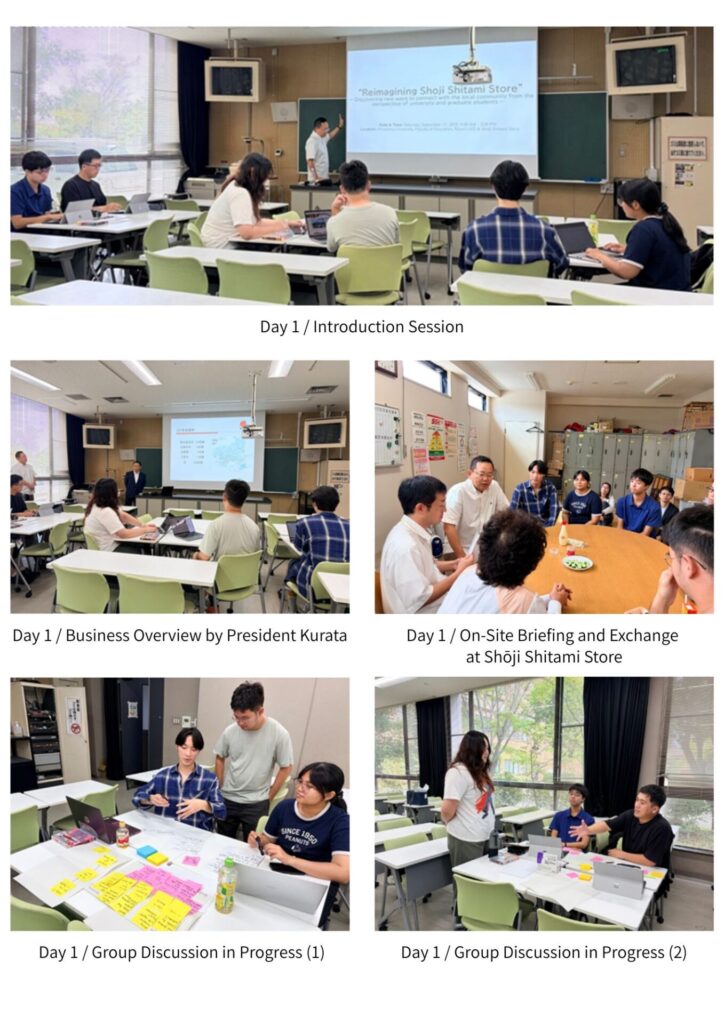
As part of the Ministry of Education, Culture, Sports, Science and Technology’s Support Project for Creating Social Impact through University Internationalization, Hiroshima University conducted the Regional Issue Collaborative Workshops on September 27(Sat.), and October 1, 2025. (Wed)
Organized in cooperation with Saijo Shoji Co., Ltd., the workshops utilized the company’s Shōji Shitami Store as the field site. Six students—three Japanese and three international—participated in the program, working together to explore innovative approaches to building connections with the local community.
Following the Regional Issue Collaborative Methodology course offered in Term 2, these workshops were led by Associate Professor Shunsaku Komatsuzaki of the IDEC International Collaboration Center. It employed an EIBL (Experiential and Inquiry-Based Learning) approach, encouraging students to engage with real-world issues through observation, dialogue, and hypothesis-building.
The first day began with a business overview by Mr. Ryo Kurata, President and CEO of Saijo Shoji Co., Ltd., followed by fieldwork at the Shitami store. Students observed the store environment, conducted interviews with staff, and began formulating hypotheses through iteractive exploration of “Problems”, “Needs”, and “Values”. Discussions centered on key questions such as “What value does the Shitami Store provide to the local community?” and “How can they take new roles in the neighborhood?” A wide range of ideas emerged, incorporating perspectives on daily life, cultural diversity, and multilingualism.
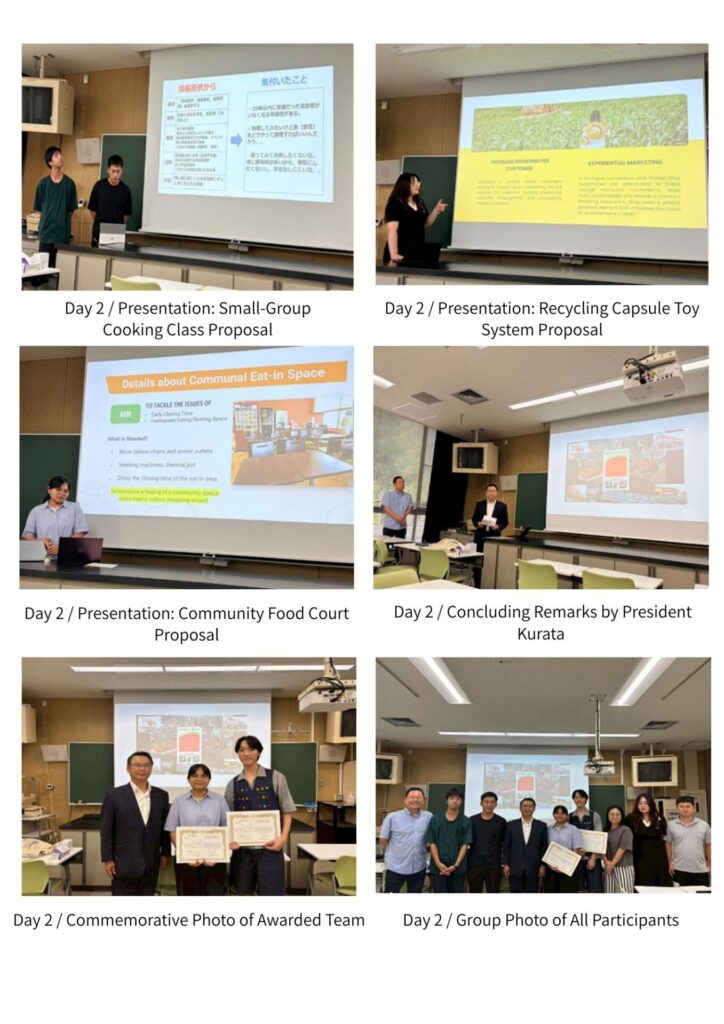
On the second day, participants refined their insights into concrete proposals, resulting in the following three concepts:
Team 1: Small-group cooking classes using ingredients sold at Shōji
Team 2: A capsule toy system linked to PET bottle recycling machines
Team 3: A phased development plan for a community food court
After the presentations, a lively Q&A sessions were held with Mr. Kurata and Prof. Komatsuzaki. Students discussed feasibility, cost, safety, and alignment with existing operations. Mr. Kurata praised the students’ community-oriented ideas and expressed his hope that they would be developed into practical, locally applicable initiatives.
The workshop offered students a valuable experiential learning opportunity in a real-world, community-based setting. Prof. Komatsuzaki emphasized the importance of deepening inquiry and refining hypotheses through dialogue, rather than seeking immediate answers. He expressed his hope that students who participated in this program would go on to create positive changes and new values in society.
Hiroshima University will continue to promote educational programs that foster students’ social awareness and problem-solving skills through collaborative, real-world learning.